1918 - 1930
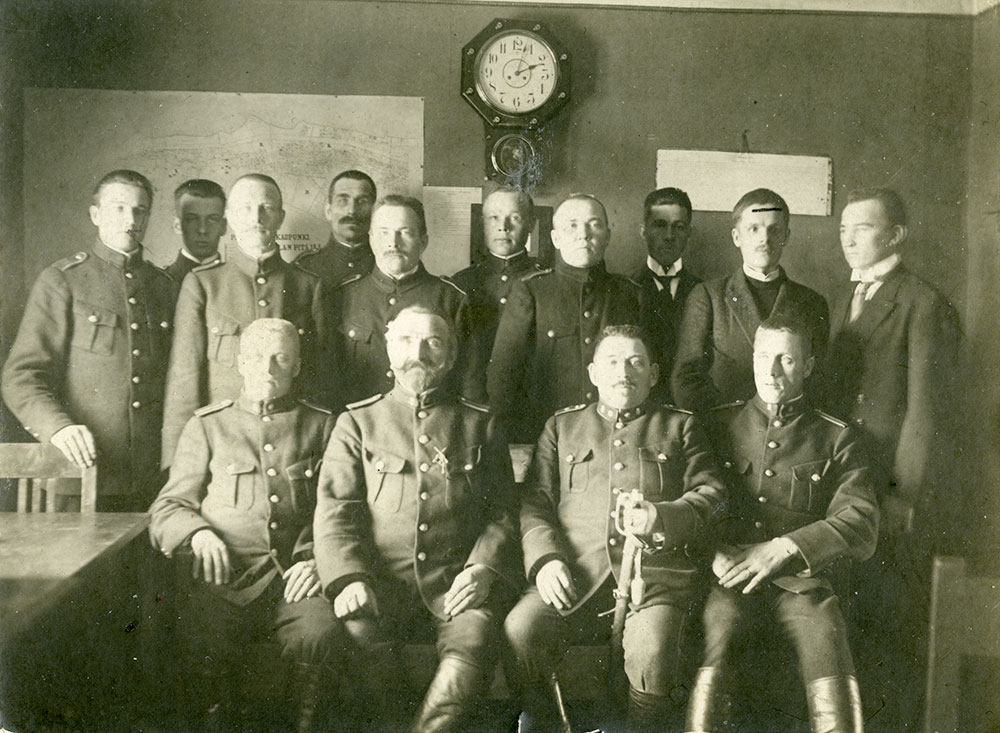
The Finnish declaration of independence on 6.12.1917 established Finland as a republic headed by a bourgeois senate, but the rivalry between Whites and Reds led to the outbreak of the Finnish Civil War in late January 1918. The war ended in May with the victory of Whites over Reds. Now that one of the parties had emerged victorious, the police organisation of the newly independent country could be built.
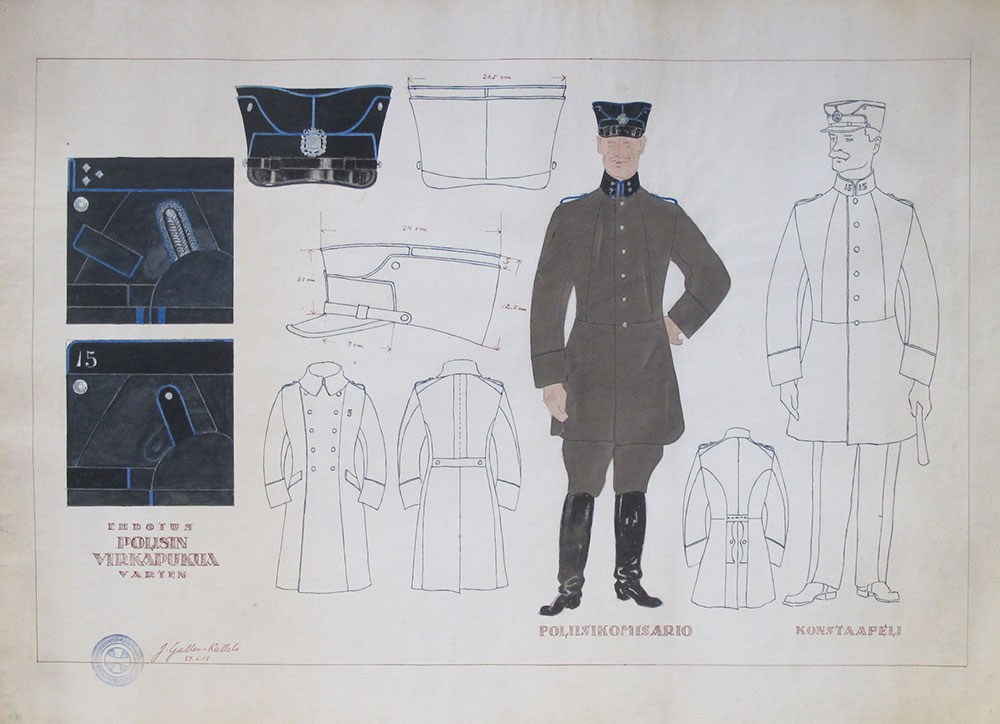
The first police uniform of independent Finland was introduced in the autumn of 1918. The uniform was dark bluish grey. The coat had buttons in one row and a foldable double collar. The collar, cuffs and the uniform cap had blue edges. The cap was black in colour and taller on the back than on the front. Although the police officer was a government employee rather than a municipal one, the coat of arms of the city he was working in was displayed on the summer and winter caps, the buttons on the coat, and on the coat collars of chief inspectors and sergeants. Rank insignia consisted of stars on the collar and shoulders of the coat.
The uniform of 1918 failed to become popular. It was considered impractical, lacking in style, and not representative of the spirit of national romanticism that it had originally been supposed to express. Among the points criticised were the uniform cap easily losing its shape, the furs of the fur cap hanging down over the officer’s eyes, the cutting of the overcoat and the excessive thickness of the coat fabric. The flawed design was caused by several factors. Most importantly, it must be noted that the uniform had been adopted in a hurry, and, above all, under the lack of material resources following the First World War in general and the Finnish Civil War in particular. Under such circumstances, it should come as no surprise that technical flaws went unnoticed and substandard materials were used. A new and better uniform would soon be needed.
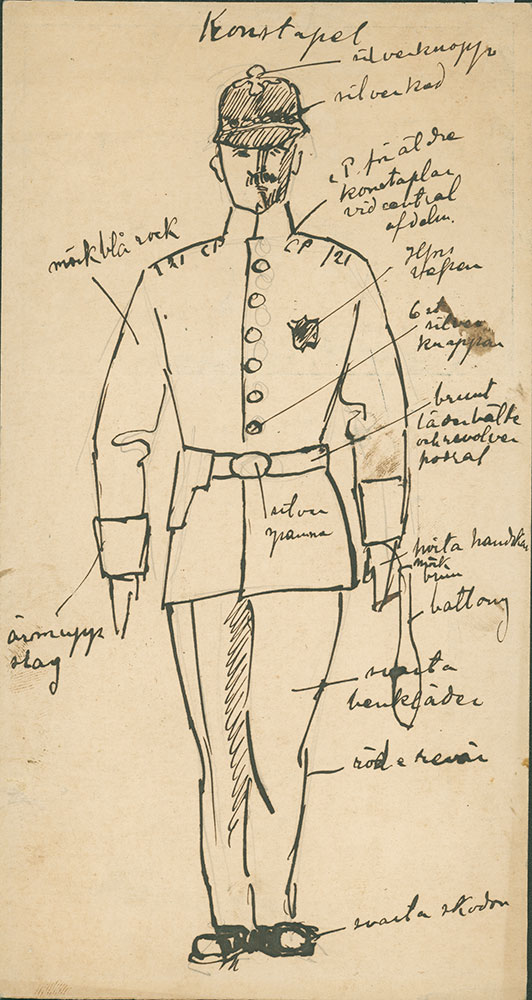
In the countryside, the uniform statute of 1907 was still formally in force, but in practice, countryside officers wore civilian clothes with a uniform cap and a metal badge. The badge of the Russian era could be made Finnish simply by removing the Russian emblem. Many officers felt no need to wear a uniform as the work was different from that of the city police. The distances a countryside officer would have to travel were often long, and since there were no police cars at the time, a uniform would only have made it more difficult to get around. Furthermore, the villagers generally appreciated unpretentiousness, and a uniform would consequently not have been appreciated by everyone.
A new statute on police uniforms was enacted in 1923. Although the uniforms of urban and rural officers were treated separately, this was the first uniform statute that concerned both. The countryside police uniform was to be identical to the city police one, the details concerning rank insignia of commanding officers constituting the only difference.
The uniform of 1923 was dark blue in colour. The coat had buttons in one row, was tight-fitting, and came with a black belt made of shiny leather. The cover of the cap was tightly fastened and had light blue piping. The cap had a textile plate with a silver provincial coat of arms surrounded by a silvery spruce wreath. Rank insignia were fastened on blue plates on the coat collar and were decorated with the same heraldic roses as those of army officers.
The new uniform was well-received and considered far superior to the previous one, above all due to its elegant appearance and the higher quality of its materials. According to the police journal Suomen Poliisilehti, the design had been inspired by the police uniform of the New York Police Department. Some officers did, however, later complain that the uniform was impractical.
A new statute on police uniforms was enacted in the late 1920s, only a few years after the previous one. Since the uniform of 1923 had no considerable flaws, the changes included in the statute were minor.